Search This Blog

Saturday, July 6, 2019

Who Was Chief Kalamalka?


Note: Dr. Duane Thomson’s article on this topic has been extremely helpful and I encourage you to read it on the Lake Country Museum’s website. I was also graciously given a copy of “Q’Sapi: A History of Okanagan People as Told by Okanagan Families” to help further expand the indigenous perspective on Kalamalka.

We hear the name “Kalamalka” so often in the Okanagan Valley but to whom did this name belong? Did a person named “Kalamalka” even exist?


A beautiful hand-tinted postcard shows the head of Kalamalka Lake
where the Chief was said to reside.


We know that he was an indigenous chief that resided at the head of what is now Kalamalka Lake or “N’Inkamuplux” (Head of the Small Lake) roughly where Kal Beach is now located. Q’sapi also tells us that: “The name Kalamalka was a prominent surname of the Okanagan Band before the turn of the century. Although now extinct, the name is well recognized and remains at Head of the Lake (Okanagan Lake) through … present surnames …” (Q’sapi p.135).

Although there are no known birth or death records for the indigenous chief known as Kalamalka, the records we do have definitely indicate not only his existence but also his profound influence on the history of the North Okanagan Valley. Historical writings also tell us that he was a man of noble reputation among both the Indigenous Peoples of the Okanagan Valley and of the early European settlers. 


A pair of moccasins originally cut out for the son of Chief Kalamalka
on display at the Greater Vernon Museum 


Historian Frank M. Buckland gives us this brief description of the chief:  “The first Kalamalka was known as a good hunter and brave man who shot a great grizzly bear at close quarters…”  (OHSR 1950, p.40). We also know that he was so popular that one of the first (and most famous) hotels built in the Valley was named after him and, eventually, one of the most beautiful lakes in the country. There is a colourful story of how Kalamalka sought to become a Christian in his later years (*see bottom of article).

Perhaps the most important document regarding Kalamalka’s existence is the obituary of his granddaughter, Katrine Bercier (aka “Coldsteam Kate”), in the February 25th, 1926 issue of the Vernon News (pg. 3). In this reference we are told that Katrine was the daughter of Chief “Goestamana” (or “Cohastimene”) who was, in turn, the son of the famous Chief Kalamalka. It also records that Chief Kalamalka was highly regarded and owned much land in the area. As an interesting side note, Katrine and Forbes George Vernon (the namesake of the city of Vernon) had a child together named Louise. Louise then married George Tronson whose father, E.J., helped lay out a town site for Vernon in 1885 (calling it “Centreville” at the time).


  Goestamana, son of Chief Kalamalka, with Ellen Ellison. Photo Credit FlyOK.ca 

As far as dating the life of Chief Kalamalka, Duane Thomson writes this: “From census data we know that Katrine was born about 1847, and Quo-hast-a-mayna about 1822. If twenty-five years also separated Quo-hast-a-mayna and his father, Chief Kalamalka, the latter was born just before 1800. He would have been about 68 years of age when the first settlers arrived in Priest’s Valley (Vernon).” Duane Thomson: Lake Country Museum blog, August 21/2015). There are also some indications that the name "Kalamalka" and perhaps even the Chief himself may have had some connections to the Hawaiian Islands - but that is a subject for another blog post. 

So it seems quite clear that a man named Kalamalka did exist and influenced the peoples and history of the Valley. In a 1979 interview with Jimmy Antoine (a descendant of Kalamalka) in the Vernon Morningstar (January 25th, 1990) Judy Gosselin records: 
"… (Jimmy) stated that the lake was named after an area chief, by the white people. Speaking through an interpreter in his native language the 90 year old Antoine said that his great grandfather, whose name sounded like “Kalamalka”, served as guardian to the head of the lake area and was leader of the people there.”

Truly Chief Kalamalka was an honourable and well-loved man. It is very fitting that such a beautiful lake bears his name and that this name lives on throughout the Okanagan Valley and abroad. I believe we owe much gratitude to this man and his descendants.


Vintage hand-tinted postcard of Rattlesnake point on Kalamalka Lake


A Story of Chief Kalamalka


*A story of Chief Kalamalka and his desire to become a Christian is recorded in Kay Cronin’s “A Cross in the Wilderness” (p132-134). The same story is retold in both “B.C. Place Names” by Akrigg (p. 130-131) and in “Q’sapi” (p136). Although baptism is not a prerequisite to becoming a Christian in most denominations, it seems Kalamalka was very keen on getting baptized. Here is the story according to Akrigg: 

“In his old age, Kalamalka was very anxious to become a Christian and repeatedly asked Father Le Jacq to baptize him. Each time the good father protested that he could not do so until Kalamalka gave up his … practice of having four wives. Loyal to his wives, Kalamalka produced reasons against putting aside any of them: one was the mother of his oldest son, another was lame from the terrible frost-bite she had suffered once when saving him amid the winter snows, and so the story continued. 

At length, Father Le Jacq was so moved by the old Indian’s constancy to his wives, along with his tremendous desire to be a Christian, that he appealed on his behalf to the bishop, only to hear his own ruling repeated – Kalamalka must settle for a single wife. 

Coming back sadly from New Westminster, Father Le Jacq received from Kalamalka the tidings that at last he had only one wife. She turned out to be none of the four, but a good looking young woman! The four wives had a held a conference, decided that a new young wife could take over a lot of the work, and had sent the chief to find a new wife while they went into retirement. And so from that day on, Old Kalamalka had one wife but supported all five women, was baptized, and, presumably, was happy.”

Wednesday, March 27, 2019

A Brief History of Military Action On Kalamalka Lake


On the east shore of Kalamalka Lake across from Kekuli Park is Cosens Bay which was once owned by Cornelius Cosens c. 1893. This land was used for military training during WW2 and “A trench was blasted out of steep rock face near Cosens Bay” (Coldstream Nulli Secundus, Page 80). 

Kal Lake and its parks were also used for combat practice during WW2. “During the war amphibious assaults were practiced on Kalamalka Lake, with the ships launching from Kekuli Bay. Guns would be firing as they approached Cosens Bay” (Know Your Park, www.kalamalkapark.ca). Many UXOs (Unexploded Explosive Ordnances) have been found in this area since but military sweeps have cleared most if not all of them.


In the 1983 edition of the Okanagan Historical Society Report (OHSR), Walker Macneil writes firsthand as a soldier who experienced some of these military activities:

“I helped the army here search for bombs after the war, and we found some in the Cosens Bay area. We used to do a lot of firing to the south and I knew there were a lot of duds there...  At one place in the Coldstream we had a simulation of a mother ship for practicing what we did on D-Day. There were ladders to climb up and the men would come down the net and get into the boat or landing craft. This gave them an idea of what they had to do. The poles were greased, and this was where we were allowed a certain percentage of injuries to people. If they slipped off they could break a rib. There was a wall to be scaled, creeks to be waded, fire pits to be climbed over and other hazards, and we were pushing them all the time, with a Bren gun firing over their heads.  One of the assault courses was located on the Coldstream Ranch, on the north side of Highway 6, in the field where the ranch kept its bulls” (OHSR 1983 p.23). 

On the south end of the lake there is some WW1 history. Annie Trask lived on what is now Kaloya Regional Park and was one of the founding members of the Kalamalka Women’s Institute and its chairperson. The KWI was a community organization that would prove especially helpful during the Great War when “convalescent soldiers were entertained by members of the Institute at the President‟s home,—“Iris Point”.” (Tweedsmuir’s History of Lake Country p.7) 
"This cairn honours Mrs. Annie L. Trask. 
Outstanding pioneer woman who founded the Kalamalka Women's Institute in Oyama B.C., February 26th, 1914. The cairn rests on the footings of the original Trask home built in 1908. It also commemorates the 75th anniversary of the K.W.I. , 1914-1989, and recognizes their continued service for "Home and Country". 

 
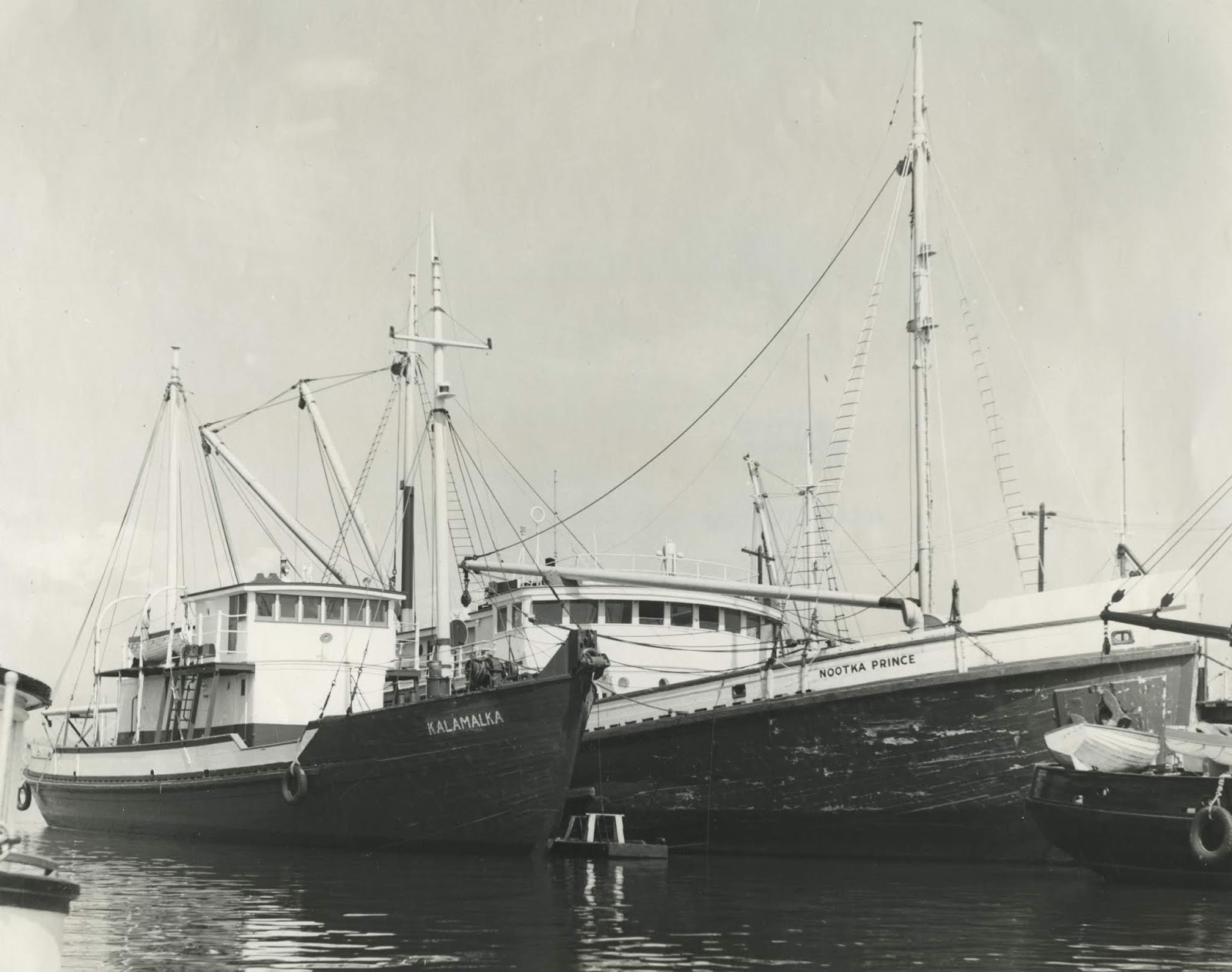
Another military note regarding the lake is that the Canadian Navy launched a mine-
sweeping vessel and named it the HMCS Kalamalka in July of 1944. She was a wooden-
hulled Llewellyn Class minesweeper and operated out of Prince Rupert as a patrol vessel 
looking for possible mines during WW2.   (https://www.canada.ca/en/navy/services/history/ships-histories/kalamalka.html)


The HMCS Kalamalka

Monday, November 12, 2018

A Brief History of the Rattlesnakes of Kalamalka Lake Provincial Park (Augustine Mackie)

"The Northern Pacific Rattlesnake is a stout snake, distinguished from all other B.C. snakes by 3 features; a rattle on the end of its tail, a very distinct neck, and a broad, triangular head.  Even their faces are unique – rattlesnakes have fairly large eyes with vertical pupils, a long, dark cheek patch, and they have deep pits between their nostrils and their eyes that contain heat-sensing cells.   The only species of rattlesnake found in B.C., the Northern Pacific Rattlesnake, also is the only truly venomous species in our province." bc.reptiles.ca


Love them or hate them, rattlesnakes are a significant part of Kalamalka Lake’s history – especially on the north-eastern shores where Kalamalka Lake Provincial Park has now been established. The early European settler’s tended to take a negative view of the rattlesnake as is seen in many passages of the Okanagan Historical Society Reports. This attitude pervaded into the early 20th century as can been seen in this WW2 soldier’s account of his training time in the area:

“One of the first things they taught us in Vernon was to catch rattlesnakes on the range at Rattlesnake Point. We had a big wooden barrel and in that barrel we usually kept five or six rattlesnakes. We did a lot of roaming around these hills with our units and many of the boys didn't even know what a rattlesnake looked like or what he sounded like.” (Walker MacNeil, OHSR 1983 p.23)

But as for the most famous of all rattlesnake hunters in the Okanagan we must look at the story of the Mackie brother’s Vernon Preparatory School for Boys during the Polio outbreak of 1927, the death of one young student by venom and the deep grief and eventual revenge that it created in the heart of Augustine (Austin) Mackie. Austin’s brother Hugh Mackie tells the story:


Photo Credit: web.uvic.ca


“In the range camp were two brothers, sons of Mr. and Mrs.  Norman Whittall, a well-known Vancouver business man. As the time of our release drew near, Mrs. Whittall decided to come up to take her boys home and wrote to tell them so. The younger lad, a charming little chap and a special favourite of mine for the previous four or five years, decided to give his mother a pleasant surprise: he would get her some rattlesnake skins for a belt. 

The  day before she arrived, he and a friend, without telling anyone of  their intention, slipped out of the camp - it was impossible to  prevent such a thing with so many tents so widely separated - and  went up to the top of the hill overlooking Ravine (Deep) Lake  where there were many caves in the rock. They must have previously discovered the particular one they were making for (we knew nothing of its existence) and knew it to be the haunt of rattlers… 

 The boy made two fatal mistakes: he under-estimated the distance a snake can strike and over-estimated the length of his stick.  Almost at his first blow he was bitten by a large snake. Then he made the worst mistake of all - instead of gashing the wound with his knife (if he had one) he dropped his stick and rushed down to the camp over a mile away, thus accelerating the spread of the venom throughout his body. He arrived in a complete state of exhaustion and shock and we instantly got in touch with the Doctors in Vernon, only to be informed that there was no "anti-venom” on hand, either in Vernon or Kelowna, or in fact in the entire  Province. The nearest supply was in the U.S.A. - Washington or Oregon.

 No plane was available there - a messenger was rushed off on a motor-cycle, but it broke down near the border, and the plasma did not arrive till late the next day. By then it was too late - the poison had spread all over the body and in the afternoon the poor little victim died…. 

After young Whittall’s death, my brother vowed vengeance upon the whole tribe of them and so started the campaign against them which made his name familiar throughout B.C. and beyond. He was tireless in hunting them down, not only throughout the Okanagan Valley, and around Kamloops, but in Alberta too. By the time increasing years (86) prevented any more such activities, he had accounted for well over 4,000...” (OHSR 1965 p. 48-49)


Vernon Preparatory School c. 1932


In this haunting story we can see the personal agony that must have driven Austin Mackie but, of course, we can also appreciate that this was not a positive response and the rattlesnakes of Kalamalka suffered for it. 


Many years later, in June of 1985, James Malcolm Macartney, a biology student at the University of Victoria, published his master’s thesis: “The Ecology of the Northern Pacific Rattlesnake, Crotalus viridis oreganus, In British Columbia”. Much of the detailed study took part in Kalamalka Lake Provincial Park and the lands belonging to the Coldstream Ranch – the same areas that Mr. Mackie would have hunted. This study has since become a foundational Rattlesnake study for biologists all over North America.

Macartney reported 15 dens (or Hibernacula) in Kal Park and another 7 dens on the Coldstream Ranch in the early 1980’s. The total number of snakes found accounted for was far fewer than the estimated number of rattlesnakes killed by Mr. Mackie alone. (p. 5, 20-21).

In 2018, Marcus Atkins, a biology student at Thomson Rivers University undertook a study to follow up on Macartney’s famous thesis. He has been working closely with the rattlesnakes in the same areas and hopes to have results in late 2019. It is hoped that Rattlesnake numbers have increased and a balanced ecosystem can become the norm for this area. 


The Northern Pacific Rattlesnake is the only rattlesnake found in British Columbia and one of only three remaining rattlesnake species in all of Canada (wildsafebc.com). Photo Credit: Dr. Karl Larsen


Rattlesnake safety tips from wildsafebc.com:

Rattlesnake bites are very rare in British Columbia and are almost never fatal. Most snake bites are due to people deliberately trying to handle or harm rattlesnakes. The most important thing to remember is to get the victim to the hospital.

If you are bitten:

1. Stay calm and remove yourself from the area. Move slowly or be carried.

2. Remove any constrictive clothing or jewelry, which otherwise would act as a tourniquet and concentrate the venom and prevent fresh blood from entering the area (which is not desirable).

3. Go to the nearest hospital. Phone ahead if possible, or phone 911. Preferably, have someone else drive you.

4. Mark swelling with lines and times every 10 minutes or so. This will help doctors assess the severity of the bite.

5. If necessary, you may clean the bite area to prevent further infection.

6. Do not:

· Apply a tourniquet

· Make an incision

· Attempt to suck out the venom

· Ice the wound

· Kill the snake


· Bring the snake to the hospital. Snakes are protected by law and doctors do not need to identify a snake to treat snakebite in BC.

Saturday, November 3, 2018

15 Fascinating Facts About Elias Pettersson: Vancouver Canucks Star Rookie (Bio)

In the wake of Elias Pettersson’s October NHL Rookie of the Month, I have collected 15 facts about this extraordinary young man that you may find interesting…

#1 Birth

Frederick Elias Pettersson was born November 12th, 1998 in Sundsvall, Sweden, a city situated 377 kilometres north of Stockholm on the Gulf of Bothnia across from Finland. It has a surrounding population of 95,000. Fredrik Modin (won Stanley Cup with Tampa Bay Lightning on 2004) and Henrik Zetterberg (won Stanley Cup with Detroit in 2008) also were born in Sundsvall.

#2 How Do you Pronounce That?

The correct pronunciation is: ee-LEE-as petter-SHON

#3 Hometown Hockey & Goaltending

Although born in Sundsvall, Elias grew up in a small town called Ange (population 2872 in 2010) about 96 kilometres west and inland of his birthplace. While now known as a potent forward, Elias actually started off his hockey career as a goaltender with his Ange minor hockey team.


“Pettersson spent hours upon hours, more than the other kids his age, working on his skating and on his hockey skills, which helped him develop much quicker and put him a step above the rest. With his dad driving the Zamboni at the rink in Ange, it gave Elias the chance to put in some extra time on the ice that many other children never had the opportunity to do. A chance the enthusiastic young boy never knocked back.” (worldjunior2017.com)

#4 Family Love

Pettersson credits his parents for where he is today and remains close to them. “Pettersson is able to call his parents pretty much every day… “With the time difference, either I talk to them when I wake up or when they wake up.” (the province.com).

His grandmother would often drive him to the rink as a child and he also has an older brother, Emil,  who is a prospect in the Nashville Predator’s system. “(Growing up with Emil) helped me a lot,” explains Elias Pettersson. “Especially at a young age as Emil taught me a lot. Then now we'll try to check on each other’s games as much as we can and learn from each other.” (worldjunior17.com)

#5 Pro Hockey in Sweden


Pettersson made his professional debut in 2015 with TimrÃ¥ IK and then signed with the Växjö Lakers of the top tier of the Swedish Hockey League. He was a force in the SHL in his rookie year of 2017-18 with 24 goals and a total of 56 points in just 44 games passing Peter Forsberg and Henrik Sedin for points by a junior player and eventually breaking the record formerly held by Kent “The Magic Man” Nilsson.

#6 International Play

Elias has won a silver medal for Sweden in the 2018 World Juniors and a gold medal at the 2018 IIHF World Championship. Although he was left off the roster of the Swedish Olympic Hockey team he didn’t let that deter him as he continued to tear up the SHL.

#7 The 2017 NHL Draft

Although they had a 12.1% chance of winning the 1st overall pick in the 2017 NHL Draft (Only Colorado had a greater percentage), the Canucks ended up picking 5th behind New Jersey, Philadelphia, Dallas and Colorado. 

They watched as Nico Hischier, Nolan Patrick, Miro Heiskanen and Cale Makar were taken with the first four picks and then they made a very smart move – they drafted Elias Pettersson 5th overall. 

#8 First Experience with Vancouver


The Vancouver Canucks signed Elias Pettersson to a 3 year entry level deal on May 25th 2018 and he played his first NHL game – and scored his first NHL goal – against the Calgary Flames on October 3rd, 2018.

#9 Hockey Heroes

Elias’ hockey hero growing up was Peter Forsberg although he’s often compared today with the Washington Capital’s Nicklas Backstrom. He is quoted as saying: 

“I don’t like to talk about myself, but I like to be one step ahead of my opponents if I’m forechecking or in a 50-50 situation,” added Pettersson. “I always like to have a plan to win the situation. I create a lot of scoring chances for myself and my teammates and I like to pass the puck more than shoot it…I play with a lot of instincts and I like how Nicklas Backstrom plays. He makes his teammates better and creates chances for himself, but I’ve got a lot to learn to get to the next level.

#10 Comparison with the Sedins?

Pettersson met the Sedins at Rogers Arena at a post –draft combine. “I heard that they always train hard and even though you think you’re training hard, you can always train harder. I watched them through the years and they make hockey look way too easy sometimes. They are very good players and it was fun to meet them.” After that bank pass to Brock Boeser on Nov 2nd he is really looking like Henrik! 


#11 His BFF

Jonathan Dahlen! “Pettersson says: "He's my best friend from home," Pettersson said of Dahlen, who was acquired in a trade with the Ottawa Senators for forward Alexandre Burrows on Feb. 27, "and to be on the same team in Sweden and get drafted by Vancouver and be in the same NHL organization is very cool."


"I am more of a passer, he is more of a goal-scorer," Pettersson, 18, said. "First time we played together was when he moved from HV71 to Timra three years ago and we started to play together directly and we found the chemistry directly and since that [time] the chemistry has become better and better. We think the same on the ice, we know where the other player is." (NHL.com)

#12 Never Too Small

Although often looked over or criticized for his tall but thin frame, Elias has proven them wrong over and over again. On top of that he trains hard and will undoubtedly put on the necessary weight to play effectively in the NHL. 


“When the Canucks selected the Swede at the 2017 NHL Entry Draft, there was comments about his lack of size and how that may result in him taking longer to develop. What stood out in his play this year is his ability to not put himself in situations where he may get overpowered. Elusive and deceptive are perfect descriptors about his skill to slip away from defenders trying to check him.

If his opponent was able to engage him, Pettersson had the awareness to angle his skates or body to push back against the oncoming player. He would use his stick to keep the puck moving or move to a teammate to get out from the coverage as quick as possible.” (NHL.com)

#13 What a Wrist Shot

Elias has a unique type of wrist shot with an almost slinging action – as we have seen so far this year it can be lethal!  

“Pettersson’s shooting ability likens him to Patrick Laine or Brock Boeser. He is going to be a guy that can take the puck off the wall to the top of the circle and beat a goalie with his quick release and shooting ability. On top of that, he has shown Canucks brass a positionally sound and defensively responsible game, and hockey IQ that is off the charts.” (The Hockey News)


#14 Secret Talents


"Dad was very good at cycling with a unicycle when I was a little kid," said Pettersson. "I also wanted to do that, so I taught myself to learn how to do it. Then I thought it would be cool to be able to juggle, so I taught myself how to do that as well." (Vancouver Courier)

#15 Destined To Play Hockey In Vancouver?


A 5 year old Elias pops the peace sign in front of his hockey-themed  birthday cake – while wearing a Vancouver, Canada shirt! 


Sources & Further Reading:

https://theprovince.com/sports/hockey/nhl/vancouver-canucks/nhl-draft-canucks-take-elias-pettersson-with-fifth-overall-pick

http://www.worldjunior2017.com/en/news/when-hard-work-pays-off/

https://www.nhl.com/news/elias-pettersson-joins-friend-from-home-on-canucks/c-290293948

https://www.nhl.com/canucks/news/vancouver-canucks-elias-pettersson/c-298233048

https://theprovince.com/sports/hockey/nhl/vancouver-canucks/markus-naslund-was-once-a-highly-touted-rookie-his-take-on-elias-pettersson

https://thehockeywriters.com/canucks-elias-pettersson-potential/

https://www.vancourier.com/pass-it-to-bulis/elias-pettersson-has-a-unique-hidden-talent-riding-a-unicycle-while-juggling-1.23265283

https://www.expressen.se/kvallsposten/sport/holl-tal-for-laget-da-brot-han-ihop/


Wednesday, October 31, 2018

A Brief History of Kalamalka Lake and Its Colours

One Lake Becomes Many

Kalamalka Lake is a glacial lake which remained after the immense Lake Penticton (which covered most of the Okanagan Valley) receded. A study of glacial history in the Okanagan Valley by Hugh Nasmith reveals that:

“Lake Penticton formed a continuous sheet of water extending from north of Vernon to Okanagan Falls… When the level of Lake Penticton in the vicinity of Vernon fell to about 1400 feet, the chain of Kalamalka, Wood, and Ellison Lakes formed a single body of water separated from the main body of Lake Penticton.” (Late Glacial History and Surficial Deposits of the Okanagan Valley, British Columbia 1962 p.35 by Hugh Nasmith)

Today, Kalamalka’s maximum depth has been measured at 142 metres and it is roughly 16 kilometres in length reaching from Coldstream in the north to Oyama in the south where an isthmus separates it from the neighbouring Wood Lake. 


One Lake Becomes Two

At one time, however, Kalamalka Lake and Wood Lake were known as a single lake referred to by the Okanagan First Nations as “Chilutsus” (Chil-loot-sus) meaning “long lake cut in the middle”.  The Lake Country Museum records for us that: “Until the late eighteenth century, the Okanagan People hunted and fished over a wide territory, including Okanagan Lake, Kalamalka Lake and Wood Lake. Heavy goods such as loads of dried venison, fish and berries were transported there from as far away as the Coldstream valley and Silver Star mountain.” (Carol Thomson, Lake Country Museum Blog Sept. 1, 2017)

The isthmus separating the two was called "acyuÊ”c̕us" (Ac yutz oos) by the Okanagan People and it meant “a narrow crossing with thickly entwined willows (or anything closely intertwined)”. The Indigenous hunters would have to cross this land barrier with their canoes and this is probably why on early colonial maps the isthmus was known as  “The Railroad” which “…likely referred to a rail (corduroy) road made by the Okanagan people by cutting and laying down closely intertwined poles or willows to facilitate their crossing of the isthmus.” (Carol Thomson, Lake Country Museum Blog Sept. 1, 2017)


The Isthmus or “Railroad”: Vintage Postcard

We recognize this land strip today as part of Oyama with Oyama Road running alongside the shore of Wood Lake and Kaloya Regional Park shoring the Kalamalka side. There was once a creek joining the two lakes until 1908 when a navigational canal was built between the two bodies of water and still exists today. It is said that Wood Lake dropped by four feet when the canal was made until it was finally level with Kalamalka Lake.

As was mentioned, the First Nations name for this lake was originally “Chilutsus”. By 1871 though, the White settlers were referring to the northern lake as Long Lake and the southern one was once known as Pelmewash Lake. The name of Pelmewash Lake was later changed to Wood Lake in honour of Thomas Wood, an Eastern Canadian who moved from Vernon and settled there. Today the old highway that runs along Wood Lake has been named “Pelmewash Parkway” to honour the indigenous name. It wasn’t until the early 1950’s that the name “Kalamalka” was officially adopted for the northern lake.


The Colours of the Lake

Kalamalka Lake is “one of a handful of unique bodies of water known as marl lakes” (BC Parks). In the summer as the lake warms, calcium carbonate, or limestone (left by past glaciers), forms crystals that reflect sunlight. This results in a breathtaking array of blue, green and turquoise colours. When the lake cools in the winter the crystals dissolve and the normal blue colour returns. The ever changing colours and hues on the lake, along with its remarkable history and geography, truly solidify it as one of the Okanagan’s most cherished treasures.

Jade Bay depicting some of the colours of Kalamalka Lake


If you liked this blog check out Kalamalka Lake: A Historic Timeline 


"He makes me to lie down in green pastures;
He leads me beside the still waters.
He restores my soul..." 
Psalm 23


Monday, October 29, 2018

A Brief History of Kaloya Regional Park (On Kalamalka Lake)


Kaloya Regional Park is a beautiful little promontory of land extending out into the many-coloured waters of Kalamalka Lake. It has a beautiful trail loop, splendid beaches and a new playground for young children (it also has washrooms!).

Often used by the Okanagan Indians throughout history, one of the first recorded mentions of the land is that of Albert Geer buying it in 1904. Eventually Egbert and Annie Trask bought it in 1908. The Trask’s named it “Iris Point”  (aka Trask Point) and it was known as such for many years.


The Trasks had moved from Nova Scotia to Washington State and eventually came to the Oyama area. They became entranced with the southern end of Kalamalka Lake, planted an orchard on their new property and soon became active citizens in Oyama. Annie was, in fact, one of the founding members of the Kalamalka Women’s Institute and its chairperson. The KWI was a community organization that would prove especially helpful during the Great War when “convalescent soldiers were entertained by members of the Institute at the President‟s home,—“Iris Point”.” (Tweedsmuir’s History of Lake Country p.7)

There is now a cairn where the Trask house used to be. It reads:

"This cairn honours Mrs. Annie L. Trask. 
Outstanding pioneer woman who founded the Kalamalka Women's Institute in Oyama B.C., February 26th, 1914. The cairn rests on the footings of the original Trask home built in 1908. It also commemorates the 75th anniversary of the K.W.I. , 1914-1989, and recognizes their continued service for "Home and Country". 


In the Okanagan Historical Society Report of 1967 (p.190) there is listed a Dr. James McAnulty living at “Kaloya pt”. The land that now hosts Kaloya Regional Park was purchased by Al Harrison of the Regional District of the Central Okanagan in 1975. Mr. Harrison was responsible for acquiring the land for many of the parks in the RDCO including Reiswig Park, Kopje Park, and the Fintry Estates.

According to the Lake Country Museum: “Kaloya Regional Park was one of the earliest parks purchased by the RDCO. It was purchased on January 10th, 1975 for $200,000 from Overseas Diamond Sales Ltd, a development company.” (December 1, 2012 blog by Carol Thompson)


It is presumed that the name “Kaloya” is derived from a combination of “Kalamalka” and Oyama” although I have yet to find a source to confirm this…


"He makes me to lie down in green pastures;
He leads me beside the still waters.
He restores my soul..." 
Psalm 23


For more Kalamalka history check out our booklet and Facebook page: "Kalamalka: A History"

Thursday, October 25, 2018

A Brief History of the Kalamalka Hotel (Vernon, BC)


The Kalamalka Hotel was one of the first hotels to be built in Vernon and is certainly the longest lasting as it still exists today in the form of a sports-themed restaurant known as “The Kal”. It was completed in 1892, the same year that Vernon was incorporated as a city and that the Shuswap & Okanagan Railway reached Vernon and Okanagan Landing and connected them to the great transcontinental railway. 

The OHSR of 1935 (p.163) records: “When the new hotel was built in 1892 by T. E.  Crowel and J. Holland for the townsite company, the Okanagan  Land and Development Company, it was suggested that a suitable  name for it would be Kalamalka, the name of an Indian living on  what was then the Indian Reserve at the end of Long Lake and of  the range bordering the lake. The name then was frequently pronounced, Tanamalka.”


Vintage postcard of the early Kalamalka Hotel


Thus the hotel was named “Kalamalka” long before the lake itself. In fact some think that it was some clever marketing by the Hotel, or perhaps just its local notoriety, that influenced the re-naming of Long Lake (as it was then known) to Kalamalka. The locals were already calling it “Kalamalka” in the mid 1930’s and as one person of that day wrote: “…as there are now twenty-four other Long  Lakes in British Columbia, it is to be hoped the new name for the  lake will be adopted.” (OHSR 1935, p.165). The lake was officially re-named Kalamalka in the early 1950’s. 

An interesting story is told of how two teenage girls whose father once owned the hotel became responsible for the modern day spelling of “Kalamalka”: 

“The name, however, as it appeared on the hotel stationery after the hotel was opened was, Kalemalka, pronounced by some, Kaleem-  alka, and this was the name the hotel went by for some years.  After George R. Raymond took over the management of it he had the sign painted and put up which is still on the hotel. While it was being prepared his daughters, two charming young girls of about 15 and 16 years of age, the eldest, Ethel… and the younger, Elvie, … took a hand in what was going forward  and insisted that the name was improperly spelled; that the "e"  should be changed to an "a".  

Their father at first rather demurred, and the two girls invoking alliteration's artful aid, appealed to the  old-timers, or rather to as many of them as they knew, to know if  they were not right in their contention. Truth compels us to state that the old-timers went over in a body onto the side of the girls, and the girls carried the day, and the new form of the word soon came into general use.” (OHSR 1935, p.163-164)


The Kalamalka Hotel c.1913


The Kalamalka Hotel was a centre of social and business activity in early Vernon with many of the most prominent citizens either patronizing the hotel or even living there. All types of community events, entertainment shows and official banquets were held there. Lord Aberdeen, the Governor General of Canada and one time owner of the Coldstream Ranch, was known to patronize the hotel and the story is told of his brother-in-law, Dudley Coutts Majoribanks, would ride his horse up the stairs and into the lounge when he wished to get a drink. 

The Kalamalka Hotel was originally a grand place for this small western town costing the princely sum of $16,000 when it was built. However, as one history lover commented in 1980: “The Kalamalka Hotel downtown lost its two top floors this year to "progress." The hotel has now been deprived of its original beauty and has become just another of the plain square buildings which comprise most of the downtown area.” (OHSR 1980, p48)

Thankfully, in spite of the changes, this integral piece of Okanagan history still exists.

For more historical information please check out our booklet 
and Facebook page: "Kalamalka: A History"